Alberta iGaming License
Canada's second open online gambling market opened on 13 July 2026. Any qualified operator can register, with no cap and no requirement to incorporate in Canada. Expect a C$50,000 application, C$150,000 per site per year, an 80/20 revenue split, and 23% corporate tax, the lowest in Canada.
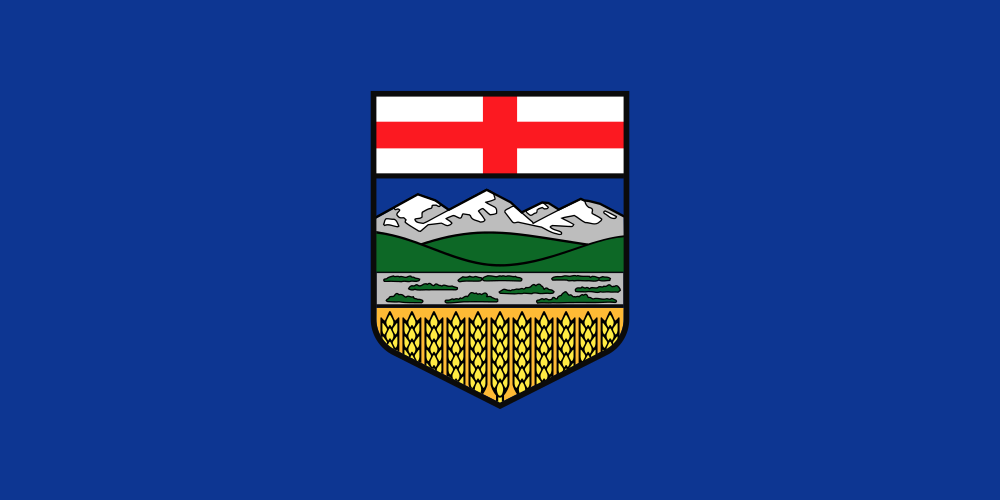





The Alberta iGaming license is an AGLC registration plus an operating agreement with the Alberta iGaming Corporation (AiGC) that lets an operator run an online casino, sportsbook, or poker legally in Alberta. The market opened on 13 July 2026 as Canada's second competitive online gambling market after Ontario.
If you already run a licensed book in Ontario or elsewhere, Alberta is an incremental-reach decision, not a bet-the-company one. The entry fee is double Ontario's headline and the market is roughly a quarter of Ontario's size. In return you get the lowest corporate tax in Canada, an 80/20 revenue split, and compliance that translates closely from Ontario.
Key facts
- Regulators
- AGLC (registrar and enforcer) plus AiGC (signs the operating agreement).
- Launch date
- 13 July 2026.
- Fees
- C$50,000 application plus C$150,000 per site, per year.
- Revenue
- 80/20 split, plus 3% of gross gaming revenue to public causes.
- Verticals
- Casino, sportsbook, live dealer, poker (ring-fenced to Alberta players).
- Minimum age
- 18, players physically located in Alberta.
- Corporate tax
- 23% combined, the lowest in Canada.
- Processing time
- Several months (due diligence plus certification).
- Crypto
- Not permitted; all play runs in Canadian dollars.
- Operator cap
- None; the market is uncapped.
Should you get an Alberta iGaming license?
Alberta is a live market, but a secondary one. Enter it if you want regulated Canadian reach beyond Ontario. You absorb a C$200,000 first-year regulatory cost against a market sized at roughly C$700M to C$1.6B in gross gaming revenue.
Do not enter for a poker business case: online poker is Alberta-players-only, and shared liquidity is not live. If your model needs crypto, Alberta is not for you, because all play runs in Canadian dollars.
Who regulates iGaming in Alberta?
Alberta copied Ontario's two-body structure, and you deal with both.
Alberta Gaming, Liquor and Cannabis Commission (AGLC): the regulator and registrar. It registers operators and suppliers, sets the Standards and Requirements for Internet Gaming (SRIG), enforces compliance, and runs the government's own Play Alberta platform.
Alberta iGaming Corporation (AiGC): the conduct-and-manage entity required by Criminal Code s.207. It signs the commercial operating agreement with each operator and handles revenue reporting.
The legal basis is the iGaming Alberta Act (Bill 48), which received Royal Assent on 15 May 2025. Under Criminal Code s.207, online gambling is lawful in Canada only where a province conducts and manages the scheme, which is why you operate as AiGC's commercial agent, the same footing operators hold under Ontario's iGaming Ontario. To take a single bet you need two things: AGLC registration and a signed AiGC operating agreement.
What documents do you need for an Alberta iGaming license?
An Alberta iGaming license application needs two document sets: personal due-diligence files for every director, officer, key person, and significant shareholder, and corporate and compliance files for the company. You prepare the personal documents; MGL prepares the corporate and regulatory file.
 Passport and personal identification
- Bank reference letter
- Professional reference
- Proof of address
- CV and source-of-funds disclosure

We simplify the British Columbia gambling license process by handling required forms, KYC, AML, responsible gaming policies, and organizational charts. Ensuring compliance with the Gaming Policy and Enforcement Branch (GPEB), we reduce paperwork and streamline your path to licensing.
MGL's responsibility:
Corporate registration and structure documentation;
financial stability evidence and UBO transparency file;
AGLC due-diligence submission for the company, key persons, and connected persons;
SRIG compliance path and technical certification coordination;
self-exclusion API integration plan;
AML/KYC and responsible-gambling policy documents.
We prepare the file so AGLC due diligence runs once, not three times.
How it works
How do you apply for an Alberta iGaming license?
Navigating the gaming license process can be complex. Here's a streamlined guide to each step.
Registration opened 13 January 2026 and the market launched 13 July 2026. Budget several months from engagement to live, driven mostly by due diligence and certification, not paperwork.
Two dates matter, and they apply to different operators. If you ran in Alberta's unregulated market before launch, you had to stop taking bets and file with fees by 13 July 2026 (a case-by-case extension to 13 October 2026 is possible on justification). New applicants with no prior Alberta activity are not locked out: registration is rolling, so you can enter after launch.
How much does an Alberta iGaming license cost?
An Alberta iGaming license costs C$50,000 as a one-time application fee plus C$150,000 per site per year. The AGLC fees and the revenue split are official figures; other lines are market-rate estimates and labelled as such.
| Fee | Amount | Notes |
|---|---|---|
| Operator application fee | C$50,000 one-time | Non-refundable |
| Operator registration fee | C$150,000 per year, per site | Per iGaming brand |
| Supplier registration (platform / critical systems) | C$15,000 per year | No application fee |
| Supplier registration (other) | C$3,000 per year | No application fee |
Revenue split: operators keep 80% of net iGaming revenue and the province retains 20%. Separately, the Government of Alberta allocates 2% of total gross gaming revenue to First Nations and 1% to social-responsibility and problem-gambling programs. The province has not publicly stated whether that 3% is deducted before the 80/20 or comes out of its own 20%, so confirm the GGR definition and deduction order in the AiGC commercial agreement before you model revenue. The 20% revenue share is a commercial arrangement, not a tax.
Corporate income tax: Alberta's 8% provincial rate is the lowest in Canada. Combined with the 15% federal rate, profit booked through a Canadian entity carries a 23% combined rate, against Ontario's 26.5%. For a profitable operation, that gap is a clear structuring advantage.
There is no bond, deposit, or minimum-capital lockup. Your C$200,000 first-year regulatory cost is an actual cost, not a refundable posting. The larger number is the operating and marketing capital you need to compete against roughly 22 live rivals and the government's own Play Alberta.
What can you offer under an Alberta iGaming license?
Permitted: online casino, sportsbook, live dealer, and regulated poker. Two constraints are worth naming before you model revenue.
Poker is ring-fenced. Regulated online poker launches for Alberta players only, a pool of roughly 4.9 million people, too thin to sustain a poker business on its own.
Pooling with Ontario is an interprovincial matter, not a court case. The Criminal Code already allows it when both provinces agree, so it needs a government-to-government deal. Alberta and Ontario are in talks but signed nothing by the 13 July launch, making this the nearer-term path to a bigger pool.
Pooling with players outside Canada is the court question. In November 2025 the Ontario Court of Appeal held that international pooling is lawful as long as the province keeps conduct and manage; the Canadian Lottery Coalition appealed to the Supreme Court of Canada, and the case is unresolved.
No crypto. AGLC-registered operators run in Canadian dollars only. A site advertising crypto to Albertans is operating offshore and illegally.
Do not build a poker case on liquidity that does not yet exist.
What are the ongoing compliance requirements?
Six obligations run continuously after registration: centralised self-exclusion, advertising limits, AML reporting, annual renewal, player eligibility, and change notifications. Failure on any of them can trigger fines, suspension, or loss of registration.
Centralised self-exclusion (a rare Alberta advantage over Ontario): a single registration excludes a person across every registered private operator, Play Alberta, and land-based venues. Every operator integrates by API before go-live, and you must offer deposit and wagering limits with a 24-hour cooling-off period before any limit is relaxed.
Advertising (formalised 18 June 2026): Ontario-style rules. Public advertising of inducements, bonuses, or credits is prohibited except on your own site or through opted-in direct marketing. No celebrities, influencers, or cartoons likely to appeal to minors.
AML: the federal PCMLTFA applies. Qualifying operators are FINTRAC reporting entities with direct obligations; AiGC coordinates AML at the provincial level through the operating agreement.
Renewal: annual registration at C$150,000 per site, conditional on continued suitability and SRIG compliance.
Player eligibility: players must be 18 or older and physically located in Alberta, enforced with geolocation on every session.
Change notifications: AGLC's Notification Matrix sets what you must report after registration, including ownership, key personnel, platform, and system changes.
What banking and payments apply in Alberta?
As a registered, AiGC-contracted operator you can access mainstream Canadian banking, and a Canadian dollar bank account is effectively required to settle. For a non-resident group, that account is the practical hurdle, not the registration itself, and MGL structures the banking setup as part of the engagement.
Player payments are CAD only: Interac e-Transfer is the primary fast rail, alongside Visa and Mastercard debit, Apple Pay, PayPal, prepaid, and bank transfer.
How does Alberta compare to Ontario and offshore?
The honest comparison: Alberta's fee-to-market-size ratio is worse than Ontario's, and both are far heavier than an offshore entry.
| Alberta | Ontario | Kahnawake | Tobique | |
|---|---|---|---|---|
| Type | Regulated market | Regulated market | Offshore licence | Offshore licence |
| Regulator | AGLC + AiGC | AGCO + iGaming Ontario | Kahnawake Gaming Commission | Tobique Gaming Commission |
| Regulated Canada access | Alberta players | Ontario players | None (global gray markets) | None (global gray markets) |
| First-year cost | C$200,000 (C$50K + C$150K/site) | C$100,000 per site | ~US$40,000 est. | ~US$43,000 est. |
| Processing time | Several months | 6 to 12 months | ~8 weeks | ~3 to 4 weeks |
| Tax | 23% corporate income tax | 26.5% corporate income tax | 0% gaming tax | 0% gaming tax |
| Revenue share | 20% (+3% to public causes) | 20% | None | None |
| Crypto | Not permitted | Not permitted | Permitted | Permitted |
| Operator cap | None | None | None | None |
| Minimum age | 18 | 19 | 18+ | 18+ |
Ontario is the larger Canadian market at half the headline entry fee; see our Ontario iGaming License page for the full comparison. Alberta's counterweight is the 23% tax rate and a self-exclusion system that already works. Kahnawake and Tobique are a different question entirely: far cheaper and faster, with no revenue share, but they authorise offshore operations only and give no legal access to regulated Canadian players.
What are the risks of entering the Alberta market?
The market is days old at launch and untested in enforcement. Supervision patterns are not established, and operator counts were reported inconsistently at launch (22 live, 28 approved, roughly 50 registered).
First Nations friction is unresolved. Treaty 8 Grand Chief Trevor Mercredi publicly criticised the 2% First Nations share and the consultation process, and the province indicated it would not raise it. This is political and reputational friction, not exclusion, so factor it into your public positioning.
You compete against the government's own book. Play Alberta held roughly 45% of the pre-launch regulated market with about 434,000 users.
Public-health scrutiny is rising. Alberta cut more than C$1M in gambling-addiction support funding around the same period it expanded gambling, so expect responsible-gambling pressure and possible tightening.
Advantages of an Alberta gaming license
Alberta pairs a regulated Canadian market with the lowest corporate tax in the country.
A 23% combined corporate rate against Ontario's 26.5%;
a centralised self-exclusion system that already works across every operator and Play Alberta;
no operator cap and no requirement to incorporate locally;
no bond or capital lockup;
if you already hold Ontario, most of the certification work carries over.
Why choose MGL for Alberta licensing
MGL has completed 250-plus licences with zero rejections. Background disclosure is where most timelines slip, so we prepare the file once and clean, so AGLC due diligence does not loop. We structure the Canadian dollar banking that trips up non-resident groups, not the registration itself. And we stay engaged after go-live, when banking gets pulled, processors fail under volume, and audits arrive. Our second-year client retention is 96%.
FAQ
Everything you need to know about Our company. Can't find the answer you're looking for? Please chat to our team.
No. Alberta's market is uncapped. Any qualified operator can register.
Yes. There is no requirement to incorporate in Canada, and multiple US-headquartered brands are live. In practice you still need a Canadian dollar bank account, transparent UBOs, and insurance. If you book the Alberta business through a Canadian entity, it carries the 23% combined rate.
The operator is the consumer-facing brand and needs both AGLC registration and an AiGC operating agreement. Suppliers (platform providers, e-wallets, oddsmakers, integrity monitors, test labs) hold a separate AGLC registration at C$15,000 or C$3,000 per year with no application fee.
No. No local-entity or office requirement applies to register.
Budget several months, driven by due diligence and technical certification rather than form-filling. We compress the timeline by preparing the disclosure file so AGLC due diligence runs cleanly the first time.
There is no formal expedited path, but Ontario's compliance requirements translate closely, which shortens the certification work in practice.
It depends who you are. Grey-market operators had to cease unregulated play and apply with fees by 13 July 2026, with a possible case-by-case extension to 13 October 2026. New applicants are not affected: Alberta uses rolling registration, so you can still enter after launch.
No. AGLC-registered operators run in Canadian dollars only. Crypto is not permitted.
Not on its own today. Poker is ring-fenced to Alberta players. A bigger pool can come two ways: an interprovincial deal with Ontario (a government-to-government agreement, the nearer-term path, nothing signed yet) or international pooling (which turns on a pending Supreme Court of Canada case). Neither is live, so model poker as upside, not base case.
Only partly. Pooling with Ontario is an interprovincial matter the Criminal Code already permits if both governments agree, so it needs a deal, not a ruling. Only pooling with players outside Canada turns on the Supreme Court appeal (the Canadian Lottery Coalition case, with Alberta intervening on Ontario's side). The nearer-term path, an Alberta-Ontario pool, does not wait on the court.
Most licensing firms close the file when registration issues. MGL stays engaged, because banking gets pulled, payment processors fail under volume, and compliance audits arrive.
Canada has no federal gambling licence. Each province decides for itself, and the terms differ sharply.
Gambling licensing in CanadaAll provincial regimes compared: who regulates, what it costs, where you can actually operateOverviewTell us your structure, ownership, and target launch. We prepare the disclosure file so AGLC due diligence runs once, structure the Canadian-dollar banking that trips up non-resident groups, and stay engaged after go-live.